Random Pokemon Generator by Generation: Gen 1 to latest Games
I built this filter after finishing my own Gen 3 Nuzlocke last year. Every time I used the generator, it kept handing me Pokemon from games I’d never actually played. Locking results to a single generation fixed that immediately, and it’s since become one of the most-used filters on this site.
Not every Pokemon fan wants to pull from the entire Pokedex at once. Some are attached specifically to the original 151 from Generation 1. Others want to explore a generation they never got around to playing. And some just want their random results to match whatever game they’re currently on. That’s what generation-based filtering is for — instead of pulling from every era combined, it narrows your result down to one specific slice of the Pokemon timeline.
What It Does
Rather than pulling from the full National Pokedex, this tool restricts every result to Pokemon that first appeared in the generation you choose. That matters because every generation has its own identity — different regions, starters, Legendaries, and even battle mechanics. Making sure that you only apply it within one generation means that the experience will be the same as whatever game or time period you are playing in.

How to Use It
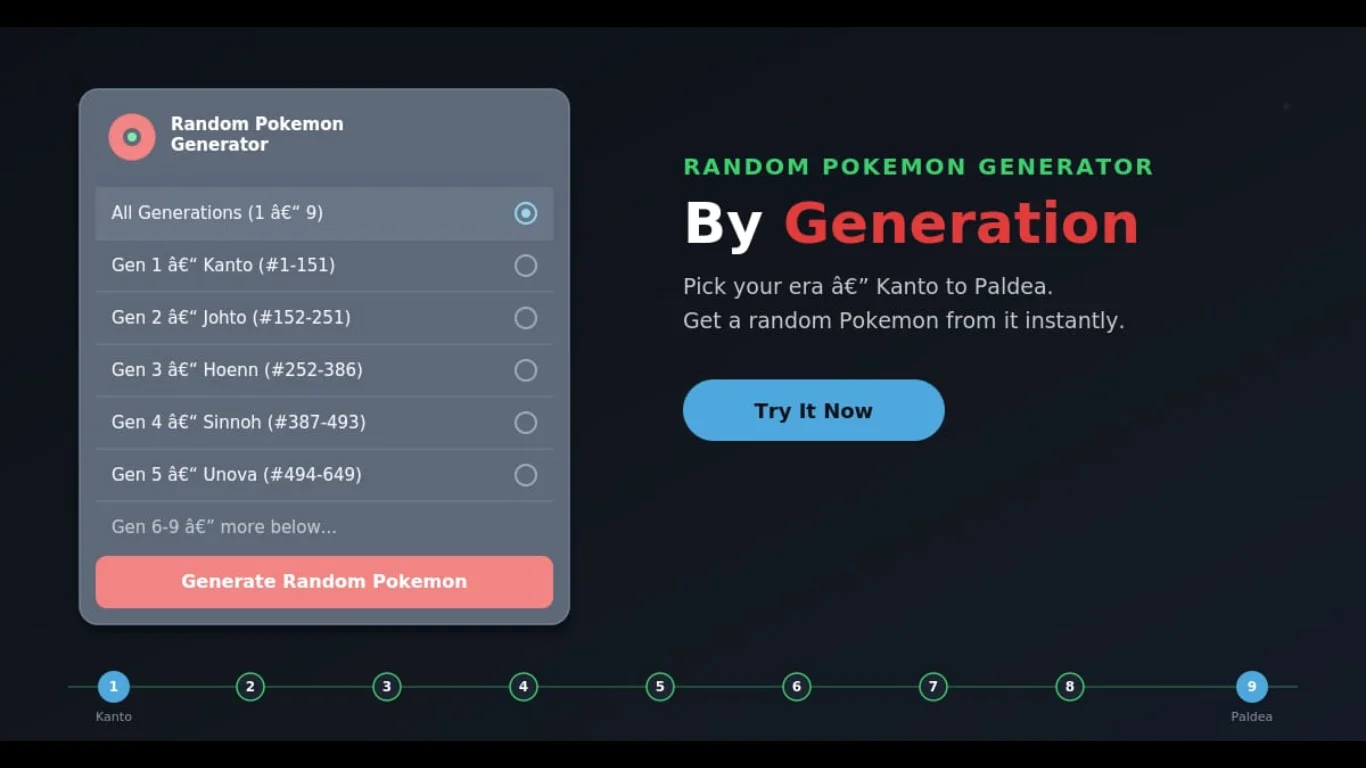
- Choose a generation from the Random Pokemon Generator’s filter menu — Gen 1, Gen 4, whichever you want.
- Click “Generate.”
- You will receive a randomly generated Pokemon, complete with its name, types, and image.
- Generate again for another result in the same generation, or switch to a different one.
Keep in mind that generation size affects how often you’ll see repeats — smaller generations (like Gen 1’s 151 species) will naturally repeat faster than larger ones.
A Few Ways to Actually Use This
Nostalgia runs. Lock results to Generation 1, 2, or 3 and revisit the era you grew up with.
Generation-matched Nuzlockes. Filter to whichever generation matches the game you’re actually replaying, so every result stays relevant.
“How well do I know this era?” trivia. Generate one Pokemon per generation and see how fast you can identify each one.
Discovering unfamiliar generations. An easy, low-effort way into an era you’ve genuinely never played.
A generation-spanning art series. Generate one Pokemon from each generation and draw the whole set, covering the franchise’s full history in one project.
Two Kinds of Players Use This Differently
For a lot of people, this filter is purely about nostalgia — revisiting the exact Pokemon they grew up with. For others, it’s the opposite: a way to finally explore a generation they’ve never touched. Both groups get real value out of it:
- Generating only from the generation you select
- Recreating the feel of a specific classic game
- Building a team that matches one particular region or era
- Running a challenge with generation-specific rules
- Rediscovering Pokemon you’d genuinely forgotten existed
- Practicing for trivia, fan games, or community events
- Adding variety to a personal challenge without hunting through a full species list
When I tried the “explore something new” approach with Generation 5, I generated Stunfisk three separate times in a row. I’ve had a soft spot for it ever since — which is honestly the appeal of this whole filter in one story.
Worked Example: Landing on Swampert
Say you filter to Generation 3 and land on Swampert. A few directions from there:
- Make it your mandatory starter for a Gen-3-only Nuzlocke.
- Compare it against other Gen 3 Water/Ground-types for a “best of the generation” ranking.
- Draw it in fan art styled after that generation’s specific game aesthetic.
Getting More Out of It
| Tip | Why It Helps |
|---|---|
| Combine with a type filter | Lets you generate something like “Generation 3 Water-types only” for a more focused result |
| Remember generation size | Smaller generations repeat results faster than larger ones — that’s expected, not a bug |
| Start with Gen 1 or Gen 2 for simpler challenges | These tend to be the most recognizable starting point if you’re new to this kind of challenge |
| Try a full generation tour | Generate one Pokemon per generation, in order, and build a team spanning the franchise’s entire history |
Generation at a Glance
Every generation offered a certain region, certain quirks in terms of mechanics, and certain stand-out Pokemon. Knowing what each generation was about would make it much simpler to choose a generation filter that really reflects your desires.
Generation 1 (Kanto, 151 Pokemon). The very first one of all. Not a single Dark or Steel type yet, not a single Ability, and only one Special stat in contrast with a Special Attack/Special Defense combination. This generation is the most “basic” one of all.
Generation 2 (Johto, 100 new Pokemon). In addition to held items and breeding, this generation saw the introduction of Shiny Pokemon and day and night cycles. It also separated the Special stat into Special Attack and Special Defense stats.
Generation 3 (Hoenn, 135 new Pokemon). Brought Abilities, double battles, and weather-based strategy into the games for the first time. This is also where a lot of long-running competitive strategies, like rain and sun teams, got their start.
Generation 4 (Sinnoh, 107 new Pokemon). Split every move into Physical or Special based on the move itself rather than its type, which fixed a long-standing balance issue. It also introduced online trading and battling through the Global Trade Station.
Generation 5 (Unova, 156 new Pokemon). Notably launched with zero returning Pokemon from earlier generations available until the post-game — every early-game encounter was brand new. It is still the largest single-generation Pokedex update in the franchise’s history.
Generation 6 (Kalos, 72 new Pokémon). Introduced Mega Evolution and the Fairy type, both designed to fix outdated strategies that became too powerful over time. It is also the first generation of games in full 3D.
Generation 7 (Alola, 88 new Pokémon). Changed the Gym concept for the Island Trial system and introduced the Alolan forms of Pokémon, changing their types and designs to the old Kanto Pokémon.
Generation 8 (Galar, 96 new Pokémon). Added Dynamic and Giantmation, Galarian forms of Pokémon, and the Wild Area, which changed the approach to exploration for the series.
Generation 9 (Paldea, 120 new Pokémon). First fully open-world entry in the mainline games series, which allows players to play the story in any order. It introduced Tera-stallizing, which is a mechanic changing the type of a Pokémon in battle for a limited amount of time.
Filtering by generation allows you to pick whatever era you wish to focus on, rather than having a mix that you may not have intended to end up with.
Common Mistakes to Avoid
Ignoring the fact that regional forms make the count confusing. Alolan Vulpix is still counted as being from Generation 7, despite Vulpix being in Generation 1. If your tool doesn’t distinguish between the base form and regional forms, make sure that you got the one you meant to work with.
Thinking that each generation provides equal chances of variation. There are more than 150 species available in Generation 5, whereas there are fewer than 75 in Generation 6.
Ignoring version-exclusive Pokemon. Some Pokemon are locked to one version within a generation — Vulpix versus Growlithe in Gen 1, for example. A generator pulling from the full generation will include both, even though a single in-game playthrough would only ever offer access to one.
Treating a generation filter as a full randomizer replacement. A generation filter changes which Pokemon can appear, not the actual mechanics of a real playthrough. It won’t replicate in-game encounter rates, and it isn’t a substitute for an actual ROM randomizer if that’s what you’re looking for.
Generation Filtering vs. Other Filter Types
It’s worth knowing how this compares to the other filtering options this site offers. A type filter narrows results to a single elemental type regardless of when that Pokemon was introduced, which is ideal for mono-type teams or type-matchup practice. A generation filter does the opposite — it locks the era but leaves type completely open, which is better suited to nostalgia, replay accuracy, or exploring an entire region’s roster. When you use both, if your tool allows it, you get the most specialized result possible – like “a Generation 4 Steel-type,” which makes the vast selection much more limited indeed.
Neither method is necessarily superior to the other. If you prefer a generation filter, use one if the importance of the game era is greater than that of the type; use a type filter if you need to construct around a certain theme, not the particular game.
Frequently Asked Questions
Does this include the most recent generation?
Yes. The generator is modified as new games are officially launched, so it displays the full franchise through the latest generation.
Can I combine a generation filter with a type filter?
Generally, yes — if the tool provide both filters together. As a result, you can create something like “a random Gen 4 Fire-type” for a more precise result.
Are regional forms counted under their original or newer generation?
This depends on the tool. Usually, though, regional forms (like Alolan or Galarian variants) are measured under the generation that introduced that specific variant.
Is one generation “more random” than another?
Not exactly. But, generations with less total Pokemon will naturally have a higher possibility of repeat results over time.
How many total Pokemon are there throughout all generations?
As of the most latest games, the official count stands at 1,025 species spanning nine generations, contaning regional forms with their own Pokedex entries.